Rau's IAS Basement Flooding: Three UPSC Aspirants Drown in a Delhi Coaching Library
Building SafetyUrban FloodingCoaching RegulationDelhiOld Rajinder Nagar, Delhi27 Jul 2024
What happened
On the evening of 27 July 2024, the basement library of Rau's IAS Study Circle in Old Rajinder Nagar, Delhi, flooded within minutes during heavy monsoon rain. Three UPSC aspirants studying there — Shreya Yadav (25), Tanya Soni (25) and Nevin Dalvin (28) — were trapped and drowned. Around 30 students were inside when the water rushed in; the rest managed to escape.
Toll
Deaths
3
Students trapped in flooded basement
30
Root cause
What directly caused this incident
Confirmed by CBI
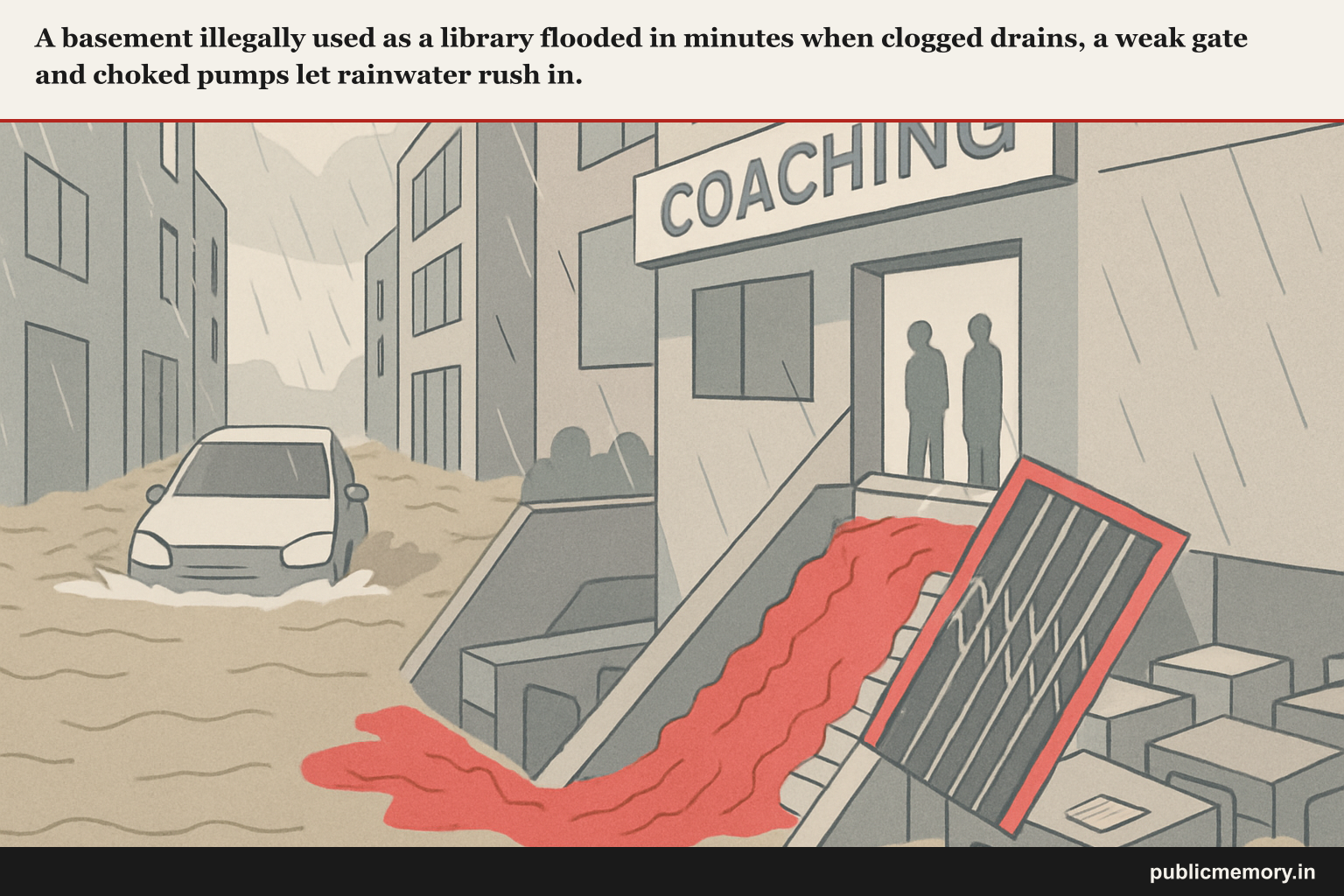
The direct cause was a fast, forced flooding of a basement that should never have held people. Heavy rain overwhelmed Old Rajinder Nagar's clogged drains, and water pooled on the sloping road outside the building. According to the CBI chargesheet, an SUV drove past and pushed a wave of water that broke through the building's main sliding gate, and the water then poured down the stairs into the basement library. A tall steel gate that staff had added at the basement entrance was found to be 'highly unstable' — an IIT Delhi expert said it ran on only two wheels with weak anchoring — and it gave way, while the two pumps meant to drain the site were choked. Within minutes the low-ceilinged library, cut up by cubicle partitions, filled almost to the roof, and the three students could not get out.
In short: In short: A basement illegally used as a library flooded in minutes when clogged drains, a weak gate and choked pumps let rainwater rush in — and the students inside had no way out.
Systemic failures
These failures existed before this incident — and will cause the next one unless the system changes.
01Critical priority
Basements used for coaching in open violation of building law, with civic bodies looking away
Partial actionAs of 1 Jul 2026
Under Delhi's Master Plan 2021 and the Unified Building Bylaws, a building basement may be used only for parking, storage or utilities — never as a classroom or a library packed with people. Rau's ran a crowded library in its basement anyway, and the building papers falsely showed that basement as a store room and parking. This was not hidden: students had formally complained weeks earlier that classes were being run illegally in the basement and that the area flooded, but no one acted. A Delhi court later said there appeared to be 'a conscious effort to ignore or permit the illegal use of the basement,' with inspections either not done or violations left out to fake compliance. The same pattern — coaching centres crammed into unsafe, non-compliant buildings while authorities do nothing — was visible in the June 2023 Mukherjee Nagar coaching fire in Delhi and the 2019 Surat coaching fire that killed 22 students.
Mukherjee Nagar coaching fire, Delhi (June 2023); Surat Takshashila coaching fire (2019)
What's being donePartial action
After the deaths the MCD sealed the basements of about 30 coaching centres across Rajinder Nagar, Mukherjee Nagar, Laxmi Nagar and Preet Vihar and issued notices to roughly 200 more; the Delhi LG suspended two senior officers and a junior engineer was arrested. Two years on, basement libraries in Old Rajinder Nagar remain shut, and new institutes in the same building run classes only on the first floor and above. But the crackdown was reactive, and the structural fix that officials promised — a Delhi law setting infrastructure and safety rules for coaching centres, announced first by then-minister Atishi and later echoed by CM Rekha Gupta — has still not been enacted.
As of 1 Jul 2026
02Critical priority
No binding law regulates the safety of coaching centres anywhere in India
Namesake — guidelines onlyAs of 1 Jul 2026
India's coaching industry teaches millions of students and earns thousands of crores, yet no national law sets enforceable rules for the fire safety, building standards or maximum occupancy of a coaching centre. The Ministry of Education's January 2024 'Guidelines for Regulation of Coaching Centres' are explicitly non-statutory — they only take effect if a state passes its own law, and most states have not. So a centre like Rau's could pack students into a basement with no fire-safety certificate and answer to no real regulator. Hearing this case, the Supreme Court called coaching centres 'death chambers' and warned of more 'Old Rajendra Nagar-type incidents'; the same regulatory vacuum lay behind the Surat and Mukherjee Nagar fires.
Surat Takshashila coaching fire (2019); Mukherjee Nagar coaching fire, Delhi (2023)
What's being doneNamesake — guidelines only
The Union government set up a high-level committee, which the Supreme Court in September 2024 ordered to submit interim safety measures within four weeks, while asking Delhi, UP and Haryana to report the legislative changes they had made. But the central guidelines remain non-binding, and no national coaching-safety law exists. Some states have moved on their own: Rajasthan passed its Coaching Centres (Control and Regulation) Bill in 2025 and Assam's cabinet approved a similar bill — but these focus mainly on student mental health and registration, not building safety, and Delhi, where this tragedy happened, still has no law.
As of 1 Jul 2026
Solved elsewhere
Rajasthan enacted a Coaching Centres (Control and Regulation) Bill in 2025 and Assam's cabinet approved a similar bill, creating mandatory registration and an oversight mechanism — though both lean toward student welfare rather than building and fire safety.
03High priority
Storm drains left unclogged for years while road levels rose around them
Partial action — cosmeticAs of 1 Jul 2026
Old Rajinder Nagar is a known low-lying pocket where rainwater collects, yet its storm drains had not been desilted for years and construction near the metro had raised the road levels so water could no longer flow away. A Delhi court found that about ₹20.9 lakh sanctioned for desilting drains in the Karol Bagh zone had no record showing how it was spent. Residents say they had warned authorities for decades and that 'the situation is the same every time it rains.' Delhi's monsoon drowning and waterlogging deaths recur every year for the same reason — silted, encroached and under-designed drains — and the National Green Tribunal has repeatedly had to set deadlines forcing the city to desilt its drains.
In the year after the deaths the MCD relaid the road outside the building and removed encroachments over the drains, and the NGT again set deadlines to desilt 24 drains before the monsoon. But a July 2026 ground report found the fixes largely cosmetic: nearby basement rooms still flood, cables hang loose and garbage chokes the pathways, and residents and a former Rau's employee called it a 'band-aid' that needs 'an infrastructure overhaul, not just a stopgap fix.' Whether the repaired stretch actually holds is untested, because the area had not yet seen heavy, continuous rain.
As of 1 Jul 2026
04High priority
Building safety certificates issued on false papers, with no independent check before public use
Partial actionAs of 1 Jul 2026
The building's completion-cum-occupancy certificate was issued on 9 August 2021 to an owner, Neelam Rani, who had died five months earlier — a sign the paperwork was rubber-stamped rather than verified on the ground. The building was taller than 15 metres but allegedly got its sanction through misrepresentation to dodge the stricter safety rules that height triggers, and the basement was cleared on paper as parking and storage. No independent body checks whether a building is actually safe for the crowded public use it is put to before it opens. The same gap — safety certificates that exist on paper but not in reality — appeared in the 2019 Surat coaching fire and in the Mukherjee Nagar building that inspectors found had 'no fire fighting equipment' while full of students.
Surat Takshashila coaching fire (2019); Mukherjee Nagar coaching fire, Delhi (2023)
What's being donePartial action
The CBI charged the coaching CEO, a coordinator and four building co-owners with criminal conspiracy and culpable homicide, and the chargesheet has been admitted to trial; the Delhi LG suspended two senior MCD officers. But accountability against the officials who signed off the false clearances has been thin — the CBI cleared the MCD deputy commissioner who held jurisdiction and an IAS officer of negligence, and a court has openly asked the CBI why MCD officials were not probed for dereliction of duty. No new system of independent pre-occupancy safety audit has been created to stop the next fraudulent clearance.