Industrial disasterChemical safetyEnvironmental clearanceCorporate accountabilityVisakhapatnam, Andhra Pradesh7 May 2020
What happened
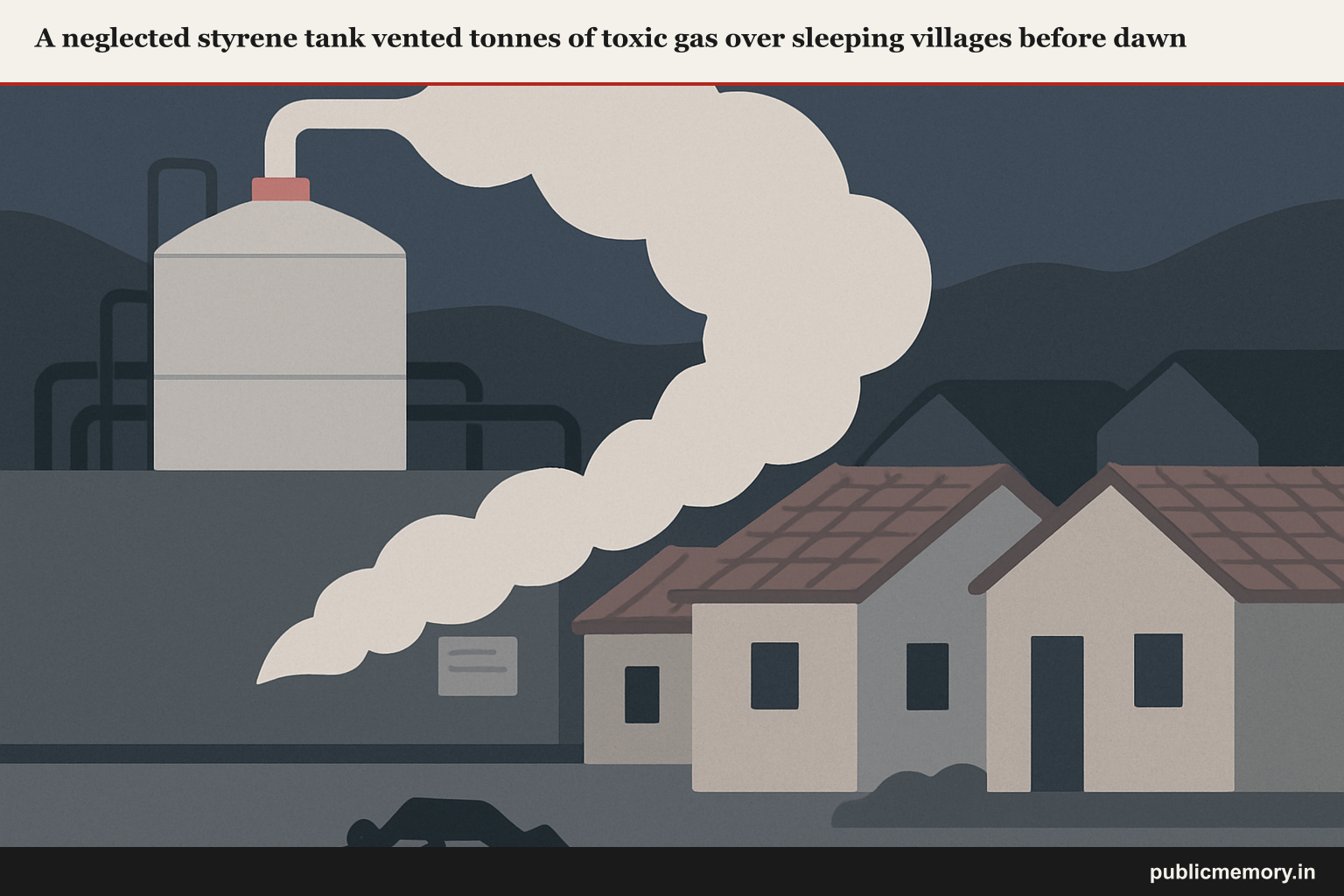
In the pre-dawn hours of 7 May 2020, styrene gas began leaking from a storage tank at the LG Polymers plant in R.R. Venkatapuram village on the edge of Visakhapatnam, as the factory was being restarted after the COVID-19 lockdown. The heavy toxic vapour rolled into the tightly packed villages around the plant while people slept, and residents woke choking, with burning eyes and collapsing on the roads. At least 12 people died and around 585 needed hospital treatment; a government committee later estimated about 3,000 people were exposed to the gas.
Toll
Deaths
13
People hospitalised
585
People exposed to gas
3000
Disputes
Deaths
Officially declared: 12
13 claimed by Several news outlets
Root cause
What directly caused this incident
Confirmed by NGT committee
The direct cause was a runaway chemical reaction inside a large styrene storage tank (called the M6 tank) that had been left idle for weeks during the lockdown. Styrene must be kept cool and mixed with an inhibitor chemical to stop it from self-reacting; when the temperature rises, it begins to polymerise on its own and release heat, which pushes the temperature higher still. The tank's cooling was inadequate, the inhibitor had run low, and the single temperature sensor sat at the bottom of the tank where it could not detect the heat building at the top. The reaction accelerated out of control, and roughly 800 tonnes of styrene vapour escaped through the tank's vents. A government High Power Committee concluded the leak was caused by 'gross human failure' and poor safety management, not an unforeseeable accident.
In short: A neglected, poorly monitored styrene tank was left to self-heat until it vented tonnes of toxic gas over sleeping villages.
Systemic failures
These failures existed before this incident — and will cause the next one unless the system changes.
01Critical priority
A hazardous factory ran for over a decade without the environmental clearance the law required — and regulators let it
Partial action — loophole legalised, then only partly reversedAs of 30 Nov 2025
Under the 2006 environmental rules, a plant handling large volumes of a hazardous chemical like styrene needs a central Environmental Clearance (EC) from the Union environment ministry before it can operate or expand. LG Polymers never had one: it ran and expanded on state pollution-board consents alone and only applied for an EC in 2018, admitting in a 2019 affidavit that it lacked a valid clearance. No authority stopped it, and the state environmental authority (SEIAA) sat on the violation file for about 18 months. This is the same regulatory blind spot seen in the 2020 Yamuna Nagar and repeated Gujarat chemical-belt accidents, where units operate for years on paper compliance while the actual hazard goes unassessed. The result is that India's flagship safeguard against exactly this kind of disaster simply did not apply to the plant that caused one.
The same pattern of long-running operation without valid environmental clearance appears across India's chemical and mining sector, later formalised through the government's 'ex-post-facto clearance' route for projects already operating illegally.
What's being donePartial action — loophole legalised, then only partly reversed
Rather than close the loophole, the MoEFCC widened it: a 2017 notification and a 2021 office memorandum created a formal path to grant 'ex-post-facto' (after-the-fact) environmental clearances to projects already built or running without one. This route was challenged, and in Vanashakti v. Union of India the Supreme Court struck the 2017 notification and 2021 memorandum down in May 2025, holding after-the-fact clearances incompatible with the right to a clean environment. But in November 2025 a differently constituted bench recalled that judgment by a 2:1 majority, quashing the 2021 memorandum only prospectively and leaving clearances already granted under it valid unless separately challenged. So the specific mechanism that legitimised illegal operation was neither firmly shut nor fully reopened.
As of 30 Nov 2025
02Critical priority
Homes were allowed to grow right up to the fence of a major-hazard plant, with no enforced buffer zone
No action taken on the underlying ruleAs of 31 Dec 2024
A factory storing thousands of tonnes of a toxic, volatile chemical is legally a 'Major Accident Hazard' unit, yet dense villages — R.R. Venkatapuram and its neighbours — sat within metres of the LG Polymers boundary. India has no strictly enforced law creating a mandatory no-development buffer around such plants, and the Visakhapatnam Urban Development Authority allowed residential settlement to expand around the site over the years. When the tank vented, the gas reached sleeping families almost immediately, which is why the toll was so high for a single tank failure. This is the defining lesson India failed to learn from the 1984 Bhopal disaster, where the Union Carbide plant was similarly ringed by shanty settlements. Without an enforced separation distance, every major-hazard unit near a town carries the same built-in death toll.
The 1984 Bhopal gas disaster and the 2020 Neyveli boiler blasts both involved hazardous industry sited beside or amid residential and worker populations with no protective buffer.
What's being doneNo action taken on the underlying rule
The government committee investigating the leak faulted the Visakhapatnam Urban Development Authority for permitting residential areas so close to the plant, and the disaster prompted renewed discussion of buffer zones around hazardous units. But no new national law mandating and enforcing a fixed safety distance around Major Accident Hazard installations was enacted afterwards; siting continues to be governed by the same weak, discretionary planning rules that existed before the leak. Enforcement of separation remains local and inconsistent.
As of 31 Dec 2024
Solved elsewhere
The European Union's Seveso III Directive legally requires member states to maintain 'appropriate safety distances' between major-hazard establishments and residential areas as a condition of land-use planning.
03High priority
The off-site emergency plan that should have warned and evacuated residents existed only on paper
Namesake — guidelines restated, enforcement gap untouchedAs of 31 Dec 2024
India's hazardous-chemicals rules (the MSIHC Rules, 1989) require every major-hazard factory and the local district to keep a tested 'off-site emergency plan' — with public warning sirens, mock drills, and a way to alert and evacuate nearby residents fast. At LG Polymers none of this worked when it mattered: the committee found the manual public-warning siren was placed where the vapour cloud made it unreachable, there was no automatic system to alert the community, and residents had never been told what to do if gas escaped. So people first learned of the leak by choking in their sleep, not from any warning. The same absence of a working public-alert and evacuation system was central to the scale of death at Bhopal in 1984. These plans are filed for compliance but rarely rehearsed, because the factory inspectorate is too thin to audit them.
The 1984 Bhopal disaster and the 2017 Tughlakabad (Delhi) chlorine leak both saw off-site emergency and public-warning systems fail or be absent when residents needed them.
What's being doneNamesake — guidelines restated, enforcement gap untouched
The National Disaster Management Authority and state factory departments reiterated existing chemical-disaster guidelines and called for more mock drills and stronger district off-site plans after the leak. But these were restatements of rules that already existed; there was no structural fix to the core enforcement gap — a chronically understaffed factory inspectorate that cannot regularly audit or rehearse off-site plans across thousands of hazardous units. Compliance therefore remains largely self-certified on paper.
As of 31 Dec 2024
04High priority
Absolute liability is settled law, but criminal accountability for industrial disasters almost never lands
Partial action — civil liability enforced, criminal accountability stalledAs of 31 Dec 2024
Since the 1986 Oleum gas case, Indian law has held that a company running a hazardous operation carries 'absolute liability' for any harm it causes — no excuses. The NGT applied exactly that here, fixing LG Polymers with absolute liability and ordering a Rs 50 crore deposit toward compensation and environmental restoration. But the criminal side moved the way it almost always does in India: the CEO, directors and officials arrested two months after the leak were granted bail within weeks, with the High Court noting most charges were bailable, and no criminal conviction has followed. This mirrors the Bhopal precedent, where a full criminal reckoning took over 25 years and ended in minor penalties. When the personal cost of a fatal safety failure is a few weeks in custody, the deterrent that is supposed to force safety spending simply is not there.
The 1984 Bhopal gas disaster prosecution dragged on for 26 years before yielding only two-year sentences; comparable industrial-death cases routinely end in bail and stalled trials.
The state pressed criminal charges (including culpable homicide) and the NGT enforced civil absolute liability with the Rs 50 crore deposit and a restoration plan, and styrene stock was shipped out of the plant. But the accused were quickly bailed, no criminal trial has concluded years on, and the incident did not prompt any statutory strengthening of penalties or a dedicated industrial-disaster prosecution mechanism. India's replacement of the old penal code did not add a purpose-built framework for corporate industrial killing either.