On 2 July 2024, a religious gathering (satsang) led by self-styled preacher Suraj Pal, known as Bhole Baba, ended in a deadly crush in Fulrai village, Hathras. As the preacher left in his convoy, tens of thousands of devotees surged forward to collect the dust from the ground he had walked on. On a muddy, sloping field beside a national highway, with a single choked exit, 121 people were trampled to death and dozens more were injured. Most of the dead were women.
Toll
Deaths
121
Women among the dead
112
Children among the dead
7
Injured / hospitalised
over 150
People at the venue
about 250,000 (permit was for 80,000)
Disputes
Injured / hospitalised
Officially declared: 80
over 150 claimed by Hospital and relief accounts
People at the venue
No official figure declared
about 250,000 (permit was for 80,000) claimed by SIT and judicial panel
Root cause
What directly caused this incident
Confirmed by SIT
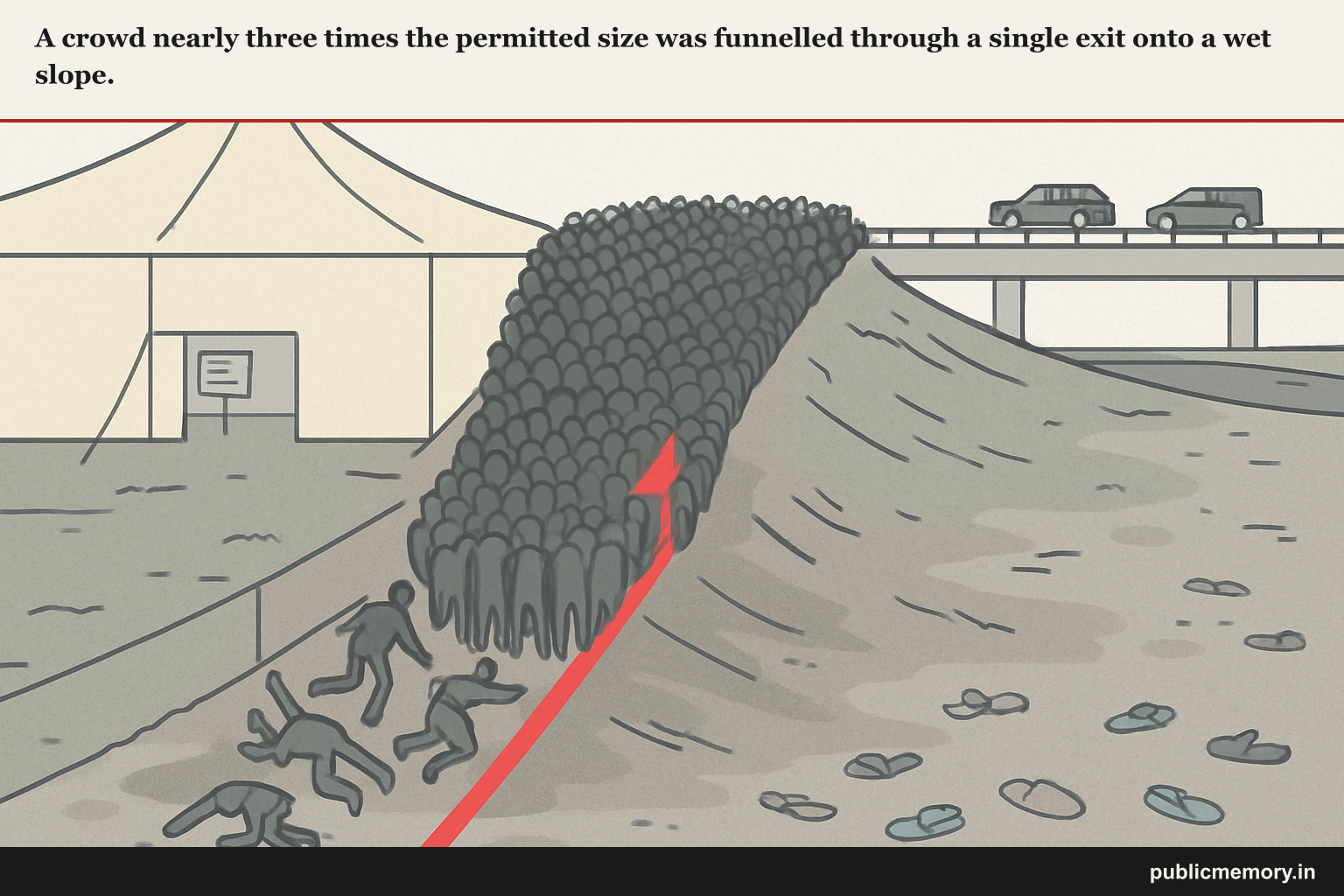
The crush happened at the end of the satsang, as the preacher left the tent for his convoy. Following a belief encouraged at such events, devotees rushed to scoop up the 'charan raj' — the dust from the ground the preacher had walked on. The crowd was funnelled onto a wet, sloping field beside a national highway that had only one usable exit and no barricading or dispersal plan. The ground was slippery from rain, and as people at the front fell, those behind kept pushing, piling bodies on the muddy slope. Investigators found the venue held an estimated 250,000 people against a permit for 80,000, with crowd control left almost entirely to the organisers' own volunteers.
In short: A crowd nearly three times the permitted size was funnelled through a single exit onto a wet slope, with no plan for how it would disperse.
Systemic failures
These failures existed before this incident — and will cause the next one unless the system changes.
01Critical priority
India has no binding law for crowd safety at mass gatherings — only advisory guidelines
India regulates crowds at huge public events through the National Disaster Management Authority's 2014 crowd-management guidelines, which are advice, not law. Because nothing in them is legally enforceable, an organiser can ignore capacity limits, exits and dispersal planning with no automatic penalty — exactly what happened at Hathras, where a 250,000-strong crowd was managed as if it were a village fair. The same gap has killed before: 115 died at the Ratangarh Mata temple in Datia, Madhya Pradesh in 2013, and more than 250 at Mandhradevi temple near Wai, Maharashtra in 2005, both from crushes on narrow, unmanaged exit routes. Even Supreme Court directions issued after Ratangarh remained advisory. Studies find that religious gatherings account for the large majority of stampede deaths in India, yet no statute makes safe crowd planning a legal precondition for holding one.
Ratangarh Mata temple stampede, Datia, Madhya Pradesh (2013, 115 dead); Mandhradevi temple stampede near Wai, Maharashtra (2005, 250+ dead).
02Critical priority
Event permission was granted without any physical inspection of the venue or an enforced cap on numbers
The gap is that a district officer can clear a mass gathering on paper without ever visiting the site or fixing an enforceable headcount. The judicial panel found the Hathras permission was processed mechanically: the application moved through several officials in hours, no one physically inspected the field, and the final order did not even state how many people were allowed, despite the application naming 80,000. That meant there was no legal ceiling to breach when 250,000 turned up, and no inspector to notice there was one narrow exit onto a wet slope. The same rubber-stamp approvals were flagged after the 2013 Datia stampede, where overcrowding warnings on the access bridge were ignored before it gave way. Six officials, including the Sub-Divisional Magistrate, a circle officer and a tehsildar, were suspended over the Hathras clearances.
Ratangarh Mata temple stampede, Datia (2013), where overcrowding warnings on the approach route went unheeded before the crush.
03High priority
The figure who drew and controlled the crowd faced no accountability, while foot-soldiers were charged
The preacher whose appearance drew a quarter-million people and whose exit set off the rush was never named in the police FIR, and a judicial commission later gave him a clean chit, blaming organisers and administration instead. Nine people including chief organiser Dev Prakash Madhukar were arrested, but the central figure — a former constable turned self-styled godman — was insulated from any charge. When the person with the most influence over a crowd bears no legal responsibility for its safety, there is no incentive for such preachers to cap attendance or invest in safety. India has no framework requiring the registration, licensing or safety accountability of the self-styled godmen who routinely draw lakhs, a gap that has let figures like Gurmeet Ram Rahim and Asaram operate huge followings for years before any reckoning. Bereaved families in Hathras publicly rejected the clean chit as unjust.
The wider pattern of self-styled godmen (e.g. Gurmeet Ram Rahim, Asaram Bapu) drawing mass followings with little state oversight or accountability until a crisis forces action.
04High priority
The state outsourced crowd control to the organisers' untrained volunteers while police stayed passive
At Hathras, security, crowd control and traffic management were handed almost entirely to the trust's own 'sevadars' — unpaid, untrained volunteers — while local police and administration took what the judicial panel called a 'passive role'. Volunteers loyal to the preacher are not equipped to hold back a surging crowd of hundreds of thousands, and at the critical moment it was reportedly the sevadars who blocked devotees' path to control the convoy, helping trigger the crush. Handing a core police duty to private volunteers removes the one actor with the training and legal authority to stop a dangerous surge. This pattern of the administration deferring to a powerful religious organiser rather than policing the event itself recurs across India's large private congregations, and the panel identified it as a fundamental failure of law enforcement's duty.
A recurring feature of large private religious congregations in India, where administrations defer crowd management to organisers' own volunteers rather than deploying trained police.