Railway SafetyTrain AccidentInfrastructureOdishaBahanaga Bazar, Balasore district, Odisha2 Jun 2023
What happened
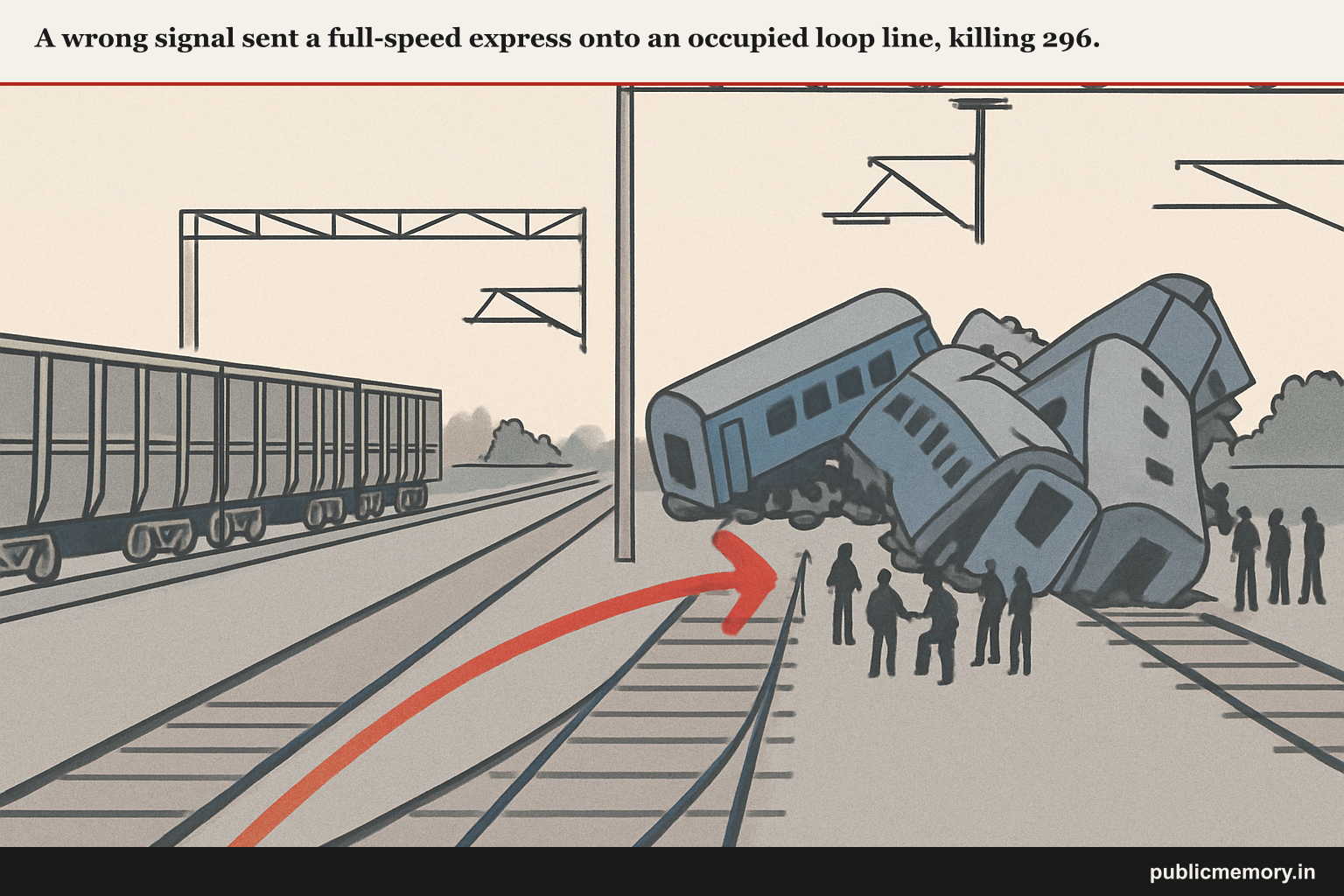
On the evening of 2 June 2023, three trains collided near Bahanaga Bazar station in Odisha's Balasore district. The Coromandel Express was wrongly routed onto a loop line where a goods train stood parked, and hit it at about 128 km/h. Derailed coaches then struck the passing Bengaluru–Howrah Superfast Express on the next track. It was India's deadliest rail disaster in more than two decades.
Toll
Deaths
293 (revised)
Injured
1200
Disputes
Deaths
Officially declared: 296
293 (revised) claimed by Odisha govt, later revision
Root cause
What directly caused this incident
Confirmed by CRS
The direct cause was a wrong signal that sent the Coromandel Express onto an occupied loop line instead of the clear main line. The Commissioner of Railway Safety found that the fault began with signalling wires that had been mislabelled inside a trackside location box and left uncorrected for years, so maintenance staff working on a level-crossing barrier at gate 94 disturbed the wrong circuit. This made the signalling system show a 'proceed' aspect for a route that was not actually set, and the loco pilot had no way to know the track ahead was blocked. The CBI charged three railway signalling staff with culpable homicide and tampering with evidence. Investigators stressed the flaw was in how signalling maintenance was documented and checked, not a one-off mistake by the driver, who could not have avoided the crash at that speed.
In short: In short: a signalling maintenance error, hidden by wires mislabelled for years, sent a full-speed express onto an occupied track.
Systemic failures
These failures existed before this incident — and will cause the next one unless the system changes.
01Critical priority
Signalling maintenance has no independent double-check to catch a wrong route
India's signalling relies on electronic interlocking that is supposed to make a wrong-route setting impossible, but the safety of that system depends entirely on the wiring being correct — and there is no mandatory independent verification that the physical wires match the circuit diagrams. At Bahanaga Bazar the wires were mislabelled from work done in 2015 and 2018 and the diagrams were never updated, so the error sat undetected for years until routine maintenance triggered it. The CRS report noted that an almost identical wrong-wiring fault had occurred at Bankra Nayabaz station just weeks earlier, and that acting on that warning could have prevented the disaster. The gap is structural: when staff disconnect and reconnect signalling circuits during maintenance, no second, independent inspection is required to confirm the connections are safe before trains run.
Bankra Nayabaz station wrong-wiring fault weeks before Balasore (2023); the 2012 Nellore and earlier signal-related collisions where wrong routing went undetected.
Solved elsewhere
European railways using proven interlocking practice require independent testing and formal 'disconnection–reconnection' verification by a second competent person before a signalling circuit is returned to service.
02Critical priority
Automatic collision-prevention (Kavach) covers almost none of the network
Kavach is India's home-built Automatic Train Protection system: it can read signals and apply the brakes on its own if a train is heading into danger, which is exactly what would have stopped the Coromandel Express. But at the time of the crash Kavach was fitted on only about 1,445 route kilometres out of a network of roughly 68,000 km — well under three percent — and the Balasore route had none of it. Anti-collision technology has been promised in India since the early 2000s, starting with Konkan Railway's anti-collision device, yet rollout has stayed slow for two decades. A BJD MP later told the Rajya Sabha the pace of Kavach installation remained far too slow to prevent the next collision. The gap is structural: the safety net that is meant to catch human and signalling error simply does not exist on most of the track trains actually run on.
2010 Sainthia and Jnaneswari Express disasters and other head-on and rear-end collisions that an automatic train-protection system could have prevented.
Solved elsewhere
European rail networks run the European Train Control System (ETCS) as standard on high-density corridors, giving automatic braking against signal-passing across most of their busy lines.
03High priority
A dedicated safety fund exists but track renewal and safety work are underfunded and underspent
In 2017 Indian Railways created the Rashtriya Rail Sanraksha Kosh (RRSK), a special fund meant to guarantee money for safety and track renewal. A 2022 CAG audit found the opposite happening in practice: money for track renewal fell from about Rs 9,608 crore in 2018-19 to Rs 7,417 crore in 2019-20, and even the priority safety works under RRSK were not being fully spent, dropping from about 82 percent to 74 percent utilisation. The same audit found inspections by track-recording cars falling short by 30 to 100 percent, meaning the physical condition of tracks was often not being properly checked. When the system that is supposed to find and fix hazards is starved of both money and inspection, dangerous faults — like mislabelled wiring or worn track — are more likely to survive undetected. The gap is structural: safety spending is treated as adjustable rather than protected, even with a fund created specifically to protect it.
The CAG found 289 of 1,127 derailments in 2017-21 were linked to track renewals, and maintenance of track was the single biggest derailment factor (171 cases).
04High priority
Huge vacancies in safety-critical railway jobs overload the staff who prevent accidents
The people who inspect tracks, maintain signals and drive trains are the last line of defence against disaster, yet these posts are chronically understaffed. An RTI reply showed that as of June 2023 about 1.77 lakh safety-category posts were vacant across Indian Railways, including roughly 20 percent of loco-pilot positions. Fewer staff means longer shifts, skipped rest days and trackmen expected to walk 8 to 10 km a day, which raises the chance of exactly the kind of maintenance and inspection errors that caused Balasore. Fatigue among overworked signal and track staff has been repeatedly flagged as a safety risk by unions and independent observers. The gap is structural: safety work is being asked of a workforce that is stretched far below its own sanctioned strength.
Loco-pilot fatigue from unfilled vacancies has been linked to signal-passing and other errors in earlier incidents flagged by railway unions and safety reviews.