The Cough Syrup That Killed: How Coldrif Reached Children Untested
public-healthdrug-regulationinstitutional-failuremadhya-pradeshchild-safetyChhindwara district, Madhya Pradesh (spreading to Parasia, Betul and neighbouring states)1 Sept 2025
What happened
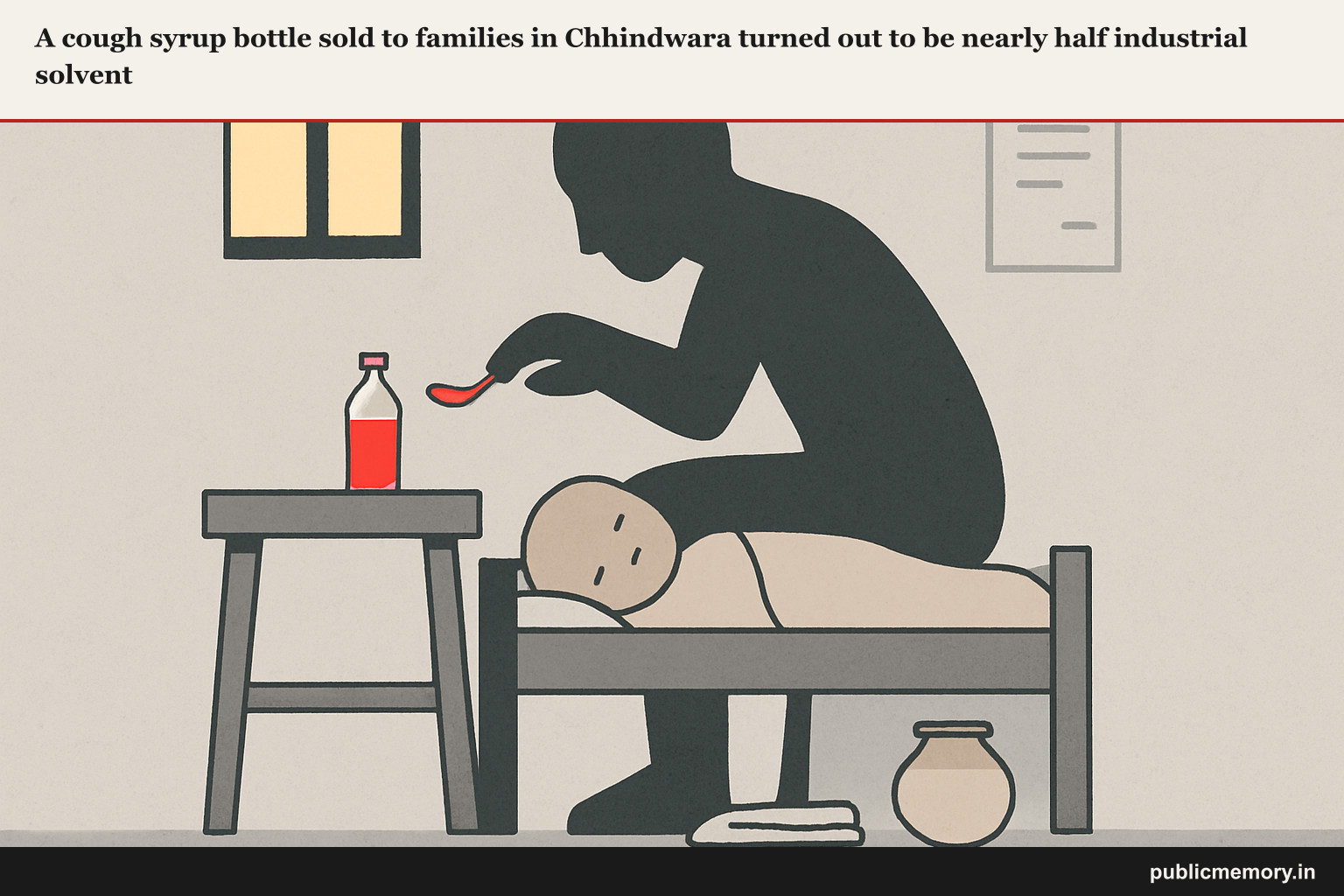
From early September 2025, infants and toddlers in Chhindwara district, Madhya Pradesh, who were given a common cold-and-cough syrup called Coldrif began developing sudden, severe kidney failure. Over the following weeks the toll climbed past 20 deaths, almost all children under five, as cases surfaced in Parasia, Chaurai and neighbouring Betul district. Lab testing traced the cause to Coldrif, made by Chennai-based Sresan Pharmaceuticals, which was found to contain diethylene glycol (DEG), a toxic industrial solvent, at roughly 46-49% concentration — around 480 times India's permissible limit of 0.1%.
Toll
Deaths
9 to 26, depending on date and district count
Children sampled/screened
1102
Disputes
Deaths
Officially declared: 24
9 to 26, depending on date and district count claimed by Media tallies across Chhindwara, Parasia and Betul as the crisis unfolded
Root cause
What directly caused this incident
Confirmed by TNFDA/CDSCO testing
Sresan Pharmaceuticals made Coldrif using propylene glycol, a solvent that must be pharmaceutical-grade and tested for DEG contamination before use. Investigators found the company instead used industrial-grade solvent, sourced through local chemical traders rather than certified pharmaceutical suppliers, because it costs less than half as much. A 2024 government audit had already found Sresan racking up over 350 critical and major violations of the Drugs and Cosmetics Act, including no qualified chemist overseeing production and raw materials that were never tested. The contaminated batch, SR-13, was sold for months before the first deaths were linked to it in early September 2025; testing and a public warning took roughly two more weeks. Tamil Nadu's drug control department has since cancelled Sresan's manufacturing licence entirely, and its owner, G. Ranganathan, has been arrested and faces culpable-homicide charges.
In short: In short: a cough syrup maker substituted cheap industrial solvent for tested pharmaceutical-grade solvent, and no inspection caught it before children died.
Systemic failures
These failures existed before this incident — and will cause the next one unless the system changes.
01Critical priority
Finished cough syrups were not required to be tested for DEG/EG contamination before sale
Before this crisis, Indian pharmacopoeia standards required testing raw glycerin and propylene glycol for diethylene glycol, but did not mandate testing the finished liquid medicine itself before it reached pharmacy shelves. That gap meant a manufacturer using untested or substituted solvent could sell a lethal batch for months with no checkpoint to catch it, which is exactly what happened with Sresan's Coldrif. The same testing gap was present in the 2019-2020 Jammu and Kashmir DEG deaths, where a contaminated syrup from a different manufacturer killed 12 children before any recall reached a child in Himachal Pradesh who died from the same batch later. Only after the 2025 deaths did the Indian Pharmacopoeia Commission amend its 2022 standard to mandate DEG/EG testing at the finished-product stage.
2019-2020 Jammu and Kashmir DEG deaths (12 children); 2020 Himachal Pradesh death from the same uncalled-back batch
Solved elsewhere
The finished-product DEG/EG testing mandate now exists in the amended Indian Pharmacopoeia (2022 standard, amended after this crisis) — but only going forward, not as a pre-2025 safeguard
02Critical priority
State drug inspectors rarely complete the inspections they are already required to do
State regulators are supposed to inspect every licensed drug manufacturer roughly once a year, and Tamil Nadu's own inspector-to-factory ratio should have made annual visits to Sresan's unit realistic. A 2024 government audit found the state completed only about two-thirds of required inspections between 2016 and 2021, and tested as few as half the samples it was supposed to — Sresan itself operated for over a decade before the 39 critical and 325 major violations at its unit were documented. This same under-inspection pattern was flagged nationally after the 2022 Gambia deaths (70+ children) linked to Indian-made syrup, when a government review found similar shortfalls in inspection completion across states, yet the completion rate had barely moved by 2025.
2022 Gambia deaths (70+ children, Maiden Pharmaceuticals) — national inspection-shortfall pattern flagged then, unchanged by 2025
03High priority
Once a licence is issued by a state, the central regulator loses track of it — even through renewal
Drug manufacturing licences in India are issued and renewed by state authorities, and states are not required to keep the central regulator, CDSCO, updated when a licence changes hands. Sresan was first licensed in 2011, but when Tamil Nadu's state FDA renewed that licence in 2016-17, CDSCO says it was never informed — meaning the central body had no live record of who was operating the plant or under what terms by the time Coldrif was made. This same central-state disconnect surfaced after the 2022 Uzbekistan deaths (Marion Biotech, Noida), where a state-suspended manufacturer's licence was allowed to lapse back into use within months because no single authority tracked the full history end to end.
2022 Uzbekistan deaths (Marion Biotech, 18 children) — licence resumed months after suspension with no unified tracking
04High priority
There is no mandatory recall system — pulling a dangerous drug from shelves is left to the manufacturer itself
When a batch of medicine is found dangerous, Indian regulators can order a ban on sale, but the physical work of pulling existing stock out of pharmacies and homes is left to the manufacturer to carry out voluntarily; regulators do not verify the recall actually happened. This gap has directly killed before: after the 2019-2020 Jammu and Kashmir DEG deaths, the contaminated syrup was never fully recalled, and the same uncollected batch later killed a child in Himachal Pradesh. A functioning mandatory-recall system, where the regulator tracks distribution and confirms every unit is pulled, would have shortened the roughly two-week gap between the first Coldrif-linked deaths and the public warning in 2025.
2019-2020 Jammu and Kashmir DEG deaths, followed by a 2020 Himachal Pradesh death from the same uncollected batch